
@lproven@social.vivaldi.net you're still missing the point.
 G
G
Graham Perrin
@grahamperrin
Posts
-
Unwrap Text (Preserve Paragraphs) ― an extension for Visual Studio Code -
Celebrating thirty-five years of Linux14th August:
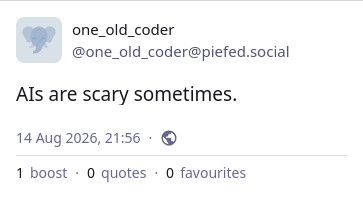
@one_old_coder@piefed.social said:
slop slop
Whilst do understand that AI can be scary for some people, there's really nothing frightening about a birthday.
Some people like to celebrate, not moan, on celebratory occasions. Maybe a brandy will lighten your mood?
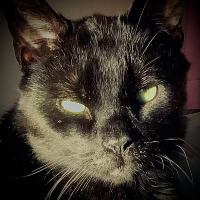
Tux―pictured below, one day after your expression of fear―is off duty this week, but I'm quite sure that he won't mind pouring a glass for you.
Pouring, or should I say serving? The new Power to Serve.

-
cylog.ai — classic DOS & Win32, reborn for the webThese are games I originally wrote from the DOS/Turbo Pascal era through the Win32/Delphi era — running on everything from DOS prompts to Windows NT, 95, XP, 2000, you name it. Chunky dialogs, raw GDI graphics, text-mode screens, and all the charm of a beige tower PC.
Now, powered by Gemini CLI and Claude Code, each title has been faithfully re-engineered to run natively in your browser. No plugins. No emulation. Just the games, reborn. …
I'm not a game-player. This is serendipity. https://bsd.network/@dvl/117172923405570692 led me to:
– thanks to @dvl@bsd.network. Seeing "atopon", I assumed Aaron Toponce.
I was wrong, of course!
atopon.orgis a division of CyLog Software:… a software house specializing in Win32 utilities and games. Our programs are free for non-commercial use. We believe that people should be able to try and use computer software freely. This is how ideas become popular and better computer software is built.
Jolly


-
Announcing Sovereign Tech Agency Investment in Flatpak — Modal Collectivehttps://modal.cx/blog/announcing-flatpak-sta/ @modal@mastodon.design
We are excited to announce a significant investment of €508,640 by the German Sovereign Tech Agency, through its Sovereign Tech Fund (STF) initiative, into the development and stewardship of Flatpak. This two-year initiative, co-organized by Modal and with Para-Real Ltd. as supporting organization, will accelerate the evolution of Flatpak as a secure, sandboxed platform for packaging and distributing Linux desktop software. …
https://mastodon.social/@openrisk/117172813501923122
Sovereign investment in #opensource software can be the most efficient use of public funds imaginable.
Its not a panacea, its not without its own risks but it has been a blind spot for too long. …
Announcing Sovereign Tech Agency Investment in Flatpak | Lobsters
Sovereign Tech Agency Providing Massive Investment Into Flatpak - Phoronix | comments
https://masto.ai/@phoronix/117170401738169097
Sovereign Tech Agency invests €500k in Flatpak | Hacker News
-
Ubuntu 26.04.1 LTS Released With Initial Collection Of Fixes – Phoronixhttps://www.phoronix.com/news/Ubuntu-26.04.1-LTS-Released
… their first point release in the long-term support series for the "Resolute Raccoon".
Ubuntu 26.04.1 LTS ships with all of the bug and security updates collected as stable release updates (SRUs) since the April release of Ubuntu 26.04 LTS. This first point release doesn't contain any new hardware enablement "HWE" stack with newer kernel and the like …
https://masto.ai/@phoronix/117170283935424930
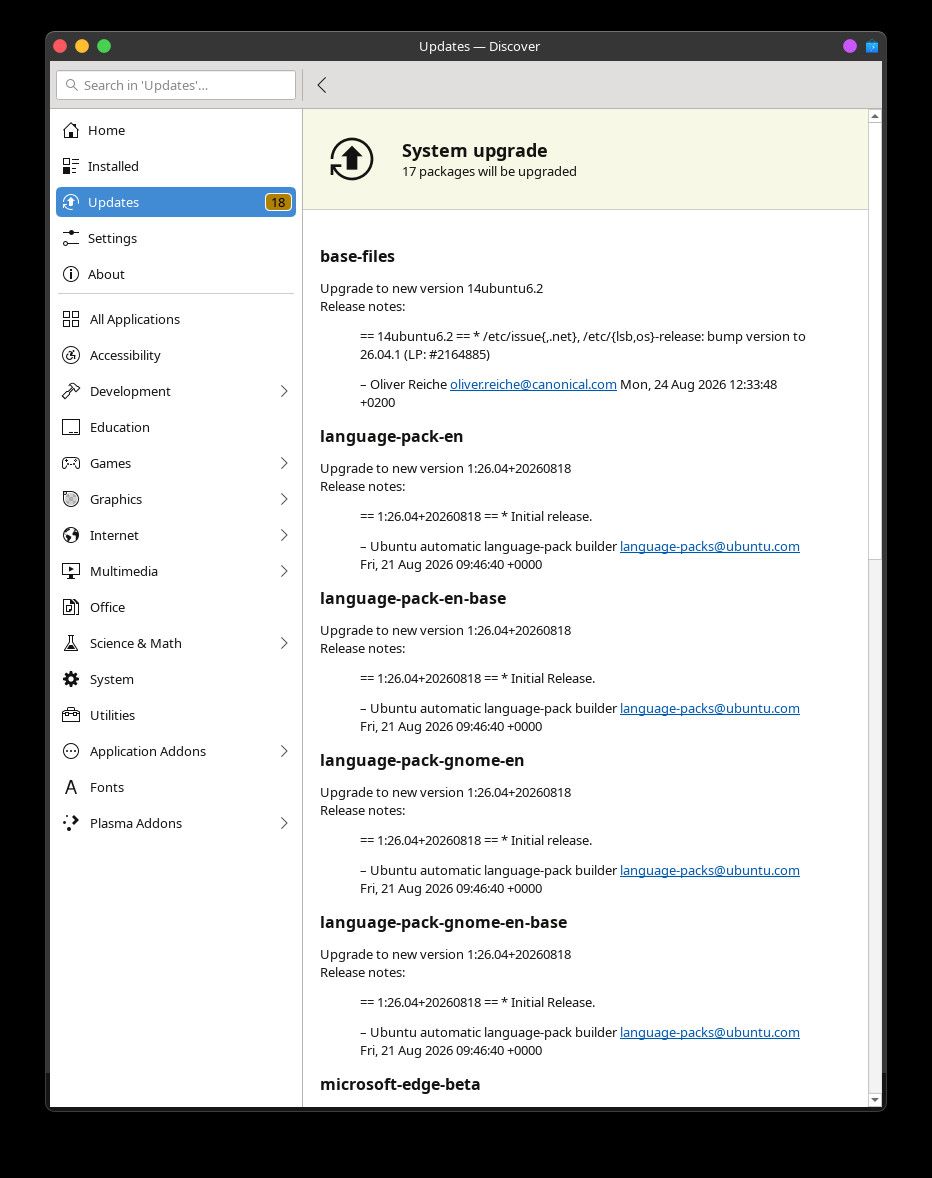
It seems that I'm gaining 26.04.1 with Kubuntu through Discover:
-
Celebrating thirty-five years of Linux
Linux 35th Anniversary - Linux.com
I'm three days late, oops:
- On August 25th, 1991, 35 years ago, Linus Torvalds announced Linux on Usenet as "just a hobby” : r/technology
- Happy 35th Birthday Linux : r/linux
- Today, Linux marks its 35th birthday! : r/linux
No 35th birthday celebrations in El Reg or Phoronix

Instead, I found something from its 12th birthday week:
Linux user and self-described cyber-conceptualist “Free” Lance Kaegle explained his absence in an instant message from his studio.
“I was organizing this boss techno-art project called ’Off The Grid,’” Kaegle wrote. “We were going to set up computer terminals in various parts of the playa and have people use them. Then we’d feed the binary data from those terminals into this fractals program that [Silver Lake, CA software designer] Ricky [Thomas-Slater] wrote. Those fractals would be sent, on the fly, to a group of exiled Buddhist monks I befriended online. The monks would transform the fractals into a temporal sand painting, the making of which we would webcast live to everyone on the playa.”
Added Kaegle: “But I had to stop working on the monk thing to finish up this Pam’s Country Crafts web site I’m working on. …” …
― No One Makes It To Burning Man Festival (2003-08-27)
Image: cropped from a Linux Foundation promotion (in the Wayback Machine)
-
[Hardware Open Source] -
Unwrap Text (Preserve Paragraphs) ― an extension for Visual Studio Codegrahamperrin said:
A single step … instead of multiple steps.
@lproven@social.vivaldi.net said:
… and repeat until …
Repetition is not a single step.
-
Unwrap Text (Preserve Paragraphs) ― an extension for Visual Studio CodeMy favourite editor last century was TextWrangler, which became BBEdit.
BBEdit's Text Handling Features | Bare Bones Software
Then, I abandoned Mac OS X, and I never found an comparable editor that did what I wanted out of the box (or with an extension).
Now, eleven years later, I'm happy.
-
[ Dan Langille ]⇒ FreeBSD backup libraries …
https://mastodon.bsd.cafe/@grahamperrin/117167186595295416 offers a possible explanation for
BACKUP_LIBRARIESset totrue. -
Unwrap Text (Preserve Paragraphs) ― an extension for Visual Studio Code@gumnos@mastodon.bsd.cafe said:
… fmt(1) or par(1)
I have only one of those:
grahamperrin@mowa219-gjp4 ~> man fmt
grahamperrin@mowa219-gjp4 ~> man par
No manual entry for par
grahamperrin@mowa219-gjp4 ~ [16]> par
Command 'par' not found, but can be installed with:
sudo apt install par
grahamperrin@mowa219-gjp4 ~ [127]>
Ubuntu Manpage: fmt - Reformat paragraphs from input (or standard input) to stdout.
– that's too complicated for me.
… Vim's …
I was a vocal hater of vi(1) before I switched from FreeBSD to Kubuntu.
Ubuntu includes nano, which was my preferred text editor on FreeBSD (editors/nano is GPLv3, so we can't expect the Project to include it with the base system).
Frustration with
viis not an isolated incident:I ran
vimfor the first time in Kubuntu, then escaped. Naturally, my first run will be my last
-
Unwrap Text (Preserve Paragraphs) ― an extension for Visual Studio Code@lproven@social.vivaldi.net said:
End.
Additional background, for readers who might not read the chat.
- Numerous fruitless searches over a period of many months
- today I used Zotero on Kubuntu to make an addition to the FreeBSD collection in my shared library
- for an abstract, I copied three paragraphs from Firefox, the result was messy
- in VSCode, for the umpteenth time, I was frustrated by the inability to get what I want with a single step
- more searches
- I experimented with an extension that lacked the required feature – IIRC its description was misleading
- I uninstalled the extension
- more searches
- I experimented with a different extension that did only part of what I want
- more searches
- thanks to Claude, which created what neither I nor Claude could find in the marketplace, I gained what was required
- I used the new extension in VSCode
- the result (the abstract in Zotero) is not messy
- I'm no longer frustrated.
The end? Hopefully not.
Someone else might benefit, might be less frustrated, as a result of the streamlining.
A single step (using the new extension), instead of multiple steps.
-
Unwrap Text (Preserve Paragraphs) ― an extension for Visual Studio CodeOn various occasions I sought, but failed to find, an extension that:
- unwraps text (removes line endings) and
- preserves blank (empty) lines between paragraphs.
After another fruitless search today, …
Result:
I tested the extension with a selection of text that comprised three paragraphs. Success.
-
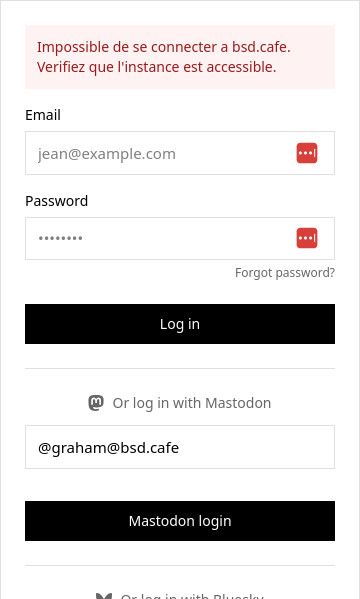
Slowly going back to the job market@Usul thanks, still not working. Also, apologies for taking things off-topic, I have flagged my first message here to be moved (with the rest of the OT thread) to the test area.
-
Slowly going back to the job marketI'll let the pono admin know.
The observation at https://mastodon.bsd.cafe/@stefano/117027174006518111 might help.
-
Slowly going back to the job marketGood luck!
Two minor nits with Ponos:
- it rejected
@graham@bsd.cafe(my advertised handle) - after it accepted the same ID
@mastodon.bsd.cafeit dit not automatically redirect to your post, I found myself at the welcome page.
- it rejected
-
NextBSD — the BSD of the 21st centuryNextBSD goal, mission and visions · nextbsd-redux · Discussion #406
The first of Joe's responses was last week. Two highlights:
… one person's trash is another persons treasure. …
– and:
- Download Server (The preview you see today, with after the superset finishes a few more touches like pkg hook to create LaunchDaemons)
- Download App (Cross platform management app)
- Download Desktop (Gershwin)
I think that when these key things roll out more, is how it will better align with the rally cry. That said I've wanted to do some research excursions and deviations out of interest here and there …
August 15 2026 - Linux compat work, ARM64 ISO lands, and KMS drivers for virtualization (WIP)
… I want virtualization on Apple silicon to work better than any other BSD starting with UTM as a first target via QEMU and the native hypervisor working as a follow up stretch goal if it can be done. …
-
littleFedia small ActivityPub server written in Go. It ships as a single static executable with a server-rendered web interface, a Mastodon-compatible client API, a durable federation queue, moderation tools, and optional PostgreSQL and S3 support. No runtime to install, no services to wire together.
Via https://littleone.littlefedi.social/@stefano/08d20839-b21b-47bc-a1b6-800d1137f36e | https://mastodon.bsd.cafe/@stefano@littleone.littlefedi.social/117076101948770274 @stefano@littleone.littlefedi.social
-
Stéphane HUC :: Echoes Weekly IT⇒ When online commenters ‘detect’ my art as AI
Reactions in Hacker News and the Fediverse:
- https://news.ycombinator.com/item?id=49188916
- https://framapiaf.org/@davidrevoy/117043735577793210 @davidrevoy@framapiaf.org
The reply from @uriel@bbs.keinpfusch.net made me giggle

-
Stéphane HUC :: Echoes Weekly IT⇒ This New Open Source Project Wants to Be the AI-First Alternative to Microsoft Office
From Sourav Rudra's article on 5th August:
… I wouldn't hold my breath for a Linux build anytime soon. …
Linux support shipped five days later.