Skip to content

World

Topics from outside of this forum. Views and opinions represented here may not reflect those of this forum and its members.

A world of content at your fingertips…

Think of this as your global discovery feed. It brings together interesting discussions from across the web and other communities, all in one place.

While you can browse what's trending now, the best way to use this feed is to make it your own. By creating an account, you can follow specific creators and topics to filter out the noise and see only what matters to you.

Ready to dive in? Create an account to start following others, get notified when people reply to you, and save your favorite finds.

Register Login
  • CiotBSDC

    (06/10)

    ⇒ A Final Return for OpenBSD Anti-Return-Oriented Programming Mitigations

    Return-Oriented Programming (ROP) continues to be a serious attack taking advantage of flaws in memory unsafe languages, particularly buffer overflows, to launch arbitrary code execution attacks by chaining together pieces of already existing code in loaded binaries and shared libraries, called gadgets. With the continued reliance on x86_64 CPUs in cloud and personal servers, mitigations that can meaningfully reduce the success of ROP attacks without significant overhead continue to be attractive. We propose the porting of one such software-based anti-ROP mitigation proposed by OpenBSD: compile-time instruction rewriting to avoid opportunities for ROP exploitation. We bring this mitigation, originally developed for the custom OpenBSD implementation of the LLVM compiler suite, to GCC by way of a standalone utility that sits in between the compiler and the assembler and rewrites potential gadget instructions before assembly into object code. Our utility provides a minimal reduction in gadgets with some penalties in binary sizes and performance impacts. We compare our GCC-ported standalone utility to the original OpenBSD LLVM mitigation and discovered that our standalone utility is weaker compared to the original LLVM-based mitigation. However, due to the overall weak reduction in gadgets for both the LLVM-based and GCC-based implementations, we conclude that seemingly obvious mitigations may prove to be anything but, and caution providing security improvements without significant testing and evaluation.


    ping: https://bsd.network/@bcallah/116725877009964245


    It seems to be my 200th post here… 😉


    26/08/11 ⇒ Cleaning costs, or, examining the OpenBSD -fret-clean flag I start with apologies to williewillus, calvin, and reezer on Lobste.rs. Prior to July 9, I would have agreed with you all. But it appears I was wrong. There is no need to further engage; it is clear that critique-from-within is undesirable. Which is perfectly OK, because I stepped away from being on the inside. So let's just keep evaluating OpenBSD's mitigations and we'll continue to learn interesting things along the way. https://briancallahan.net/blog/20260811.html
  • R

    A semi-active web forum for DOS users and developers


    Always great to see active DOS communities!
  • CiotBSDC

    26/08/03

    ⇒ Show memory information on OpenBSD

    Finding memory information and usage on OpenBSD requires a few commands and the right places to look. If you are used to Linux, then commands like free are no longer available. Let’s have a look at memory details on OpenBSD.


    26/08/05

    ⇒ Running your own mail server with OpenBSD and OpenSMTPD

    Self-hosting your own services such as a blog, website, or email is a valuable skill. It gives you a better understanding in the technology and usually also fun to do. With privacy under pressure and Big Tech continuing to store our data, this might be a good time to host your own mail server.


  • ptribbleP

    Tribblix and OmniTribblix m41 released

    http://tribblix.org/download.html

    This doesn't have any significant breaking changes on the application side, just a lot of normal version updates, but does pick up the handful of illumos CVEs we've had recently.


  • D

    No idea what happened to that tomato, but it grew into the FreeBSD logo.


    Hey, thanks! Now I know to keep them cooler.
  • CiotBSDC

    Setup a simple web server with bozohttpd on NetBSD.


  • Y

    Gentlefolk,

    I am trying to set up a wireguard client inside a Bastille jail - both the host and the jail are on FreeBSD 15.1.

    I have encountered an error (SIOCIFCREATE2 (wg0): Invalid argument) when I try to bring up the interface.

    Apparently this is because, while the host system has access to the kernel module that enables wireguard, the jail does not.

    After a bit of research, it seems that the way to handle this is to put the declaration
    if_wg_load="YES"
    into /boot/loader.conf, or perhaps into a file inside /boot/loader.conf.d.

    However, Bastille sets up /boot as a read-only filesystem.

    Hence the only way I can see to fix this is to edit the fstab for this jail and change the flags for /boot to rw from ro, restart the jail, edit the necessary files, and then go back out to the host and reset the flags in fstab.

    Now, call me an optimist, but I suspect the good folks behind Bastille will already have seen this problem and worked out a less awkward solution - I just can't find it anywhere. Am I missing something?

    Many thanks as ever,

    ---WBTD.


    ...and it was an idiot error. I had to enable wg in the host kernel. I knew it was built into the kernel these days...I just hadn't realised I needed to enable it. -->facepalm<--
  • UsulU

    If not any idea how much work that would represent?


  • CiotBSDC

    26/08/01 ⇒ MidnightBSD 4.0.7 RELEASE MidnightBSD 4.0.7 RELEASE is uploading right now. It contains a number of security updates and is recommended for all users. https://bsdsec.net/articles/midnightbsd-security-midnightbsd-4-0-7-release
  • UsulU

    I'm in my 50s, been using computers since the beginning or the 80s, been on the internet since the beginning of the 90s. I'm a computer professional, I've been

    • consultant
    • QA lead
    • SRE / Sysadmin
    • lately more support engineer.

    I have a thing for old Unix systems and workstations. I've been involved a lot into the Mozilla project and have been employee. I have a sweet spot for Apple ][s and old Unix workstation. I love SMP when it means more than one processor in the box.

    When I'm not toying with computer or spending time with the family, I like to read and I maintain a BookWyrm profile.
    I take pictures with a trusted Canon DSLR who's starting to show it's age. I post both on pixelfed and Flickr.
    I play historical miniatures war games, which means I build and paint minis.

    I'm present on two mastodon instances. And I 'maintain' 3 blogs. I've a love affair with various BSD since I got myself involved in OpenDarwin a few years back. My gaming blog runs on FreeBSD. I wish I'd run a BSD system on a daily basis but running a Fedora machine for work is complcated enough.

    Ludo


    @stefano Thank you.
  • UsulU

    There's usually booths and a room dedicated to BSD at Fosdem, seem interesting to me to add it, no?

    Ludo


  • CiotBSDC

    The Wine 11.14 development release is officially out now bringing with it an assortment of new features to improve Windows apps / games on other platforms.

    New WoW64 mode supported on FreeBSD.


  • CiotBSDC

    (06/04)

    ⇒ Linux 7.2 Will Be Able To Boot On Apple M3 Macs - But Far From Useful For End-Users

    The upcoming Linux 7.2 mainline kernel is expected to be able to boot on Apple M3 devices including the M3-powered iMac and MacBook products. But before getting too excited it's still a long ways to go before it will actually be useful for any Apple M3 daily usage under Linux with the overall support at this stage still being very limited for these 2~3 year old Apple Macs…


    (06/05)

    ⇒ Linux 7.2 Continues Improving AMDGPU Support On POWER, ARM

    In addition to AMDGPU finally seeing HDMI 2.1 FRL support in Linux 7.2, another change worth noting in this week's AMDGPU pull request is the continued work on enhancing the AMDGPU/AMDKFD kernel driver support for non-4K page size kernel builds. In particular this helps out with AMD graphics and ROCm for the likes of ARM and POWER…

    ⇒ NVIDIA's Nova Driver Continues Being Built Up In Linux 7.2 Along With Other DRM Rust Code

    Danilo Krummrich sent out the main set of DRM Rust subsystem changes on Thursday that are targeting the Linux 7.2 kernel. NVIDIA's open-source Nova driver continues seeing a bulk of the DRM Rust work as this modern successor to Nouveau continues taking shape.

    ⇒ More SpacemiT K3 & K1 Support Landing In Upstream Linux 7.2

    In addition to Apple M3 Device Trees for Linux 7.2, the SpacemiT RISC-V SoCs are seeing some notable Device Tree improvements with this next version of the Linux kernel.


    26/07/20 ⇒ Linux 7.2 Improves Intel Panther Lake Xe3 Arc B390 Graphics Performance My testing of the in-development Linux 7.2 kernel continues in the lab. One of the latest promising findings from this kernel that will be released as stable in August is faster Intel Xe3 graphics performance on Core Ultra Series 3 "Panther Lake" hardware. https://www.phoronix.com/review/linux-72-panther-lake
  • Y

    Gentlefolk,

    I brought myself back up to speed on FreeBSD by installing it on a T430 - ZFS and pkg install worked beautifully. Got Wayfire working, set up a jail to run a Luanti (Minetest) server. So far so good.

    Now I'm working on the real challenge, bringing up a Poweredge R540 which will have raid-3 ZFS and many jails. And my first problem is right at the very beginning. I can install FreeBSD (15.0) from a USB stick just fine, but when I try to get the machine to boot...

    (1) If I configure the 540 to boot from UEFI it cannot find the boot disk.
    (2) If I configure the 540 to boot from BIOS, it finds the disk and boots just fine.

    The Handbook is perhaps a bit out of date on this as it assumes BIOS, with a nod towards the possibility of UEFI. I'm guessing this problem has been solved many times over - could someone point me towards the solution?

    Many thanks,

    ---WBTD.


    ...and at long last: it wasn't a bug, it wasn't bad documentation, it wasn't BSD's fault in any way. The 540 in the 12+2 configuration has 12 drive slots on the front and 2 on the rear. Turns out that something, I have no idea what, means that while a SATA drive is recognised for boot (with UEFI) in the rear 2 plane, a SAS drive is not. It's a Weird Hardware Thing, and not something FreeBSD or the excellent handbook could, or should, ever have known about. Now I'm off sorting out VNET jails to run Nextcloud.
  • naltunN

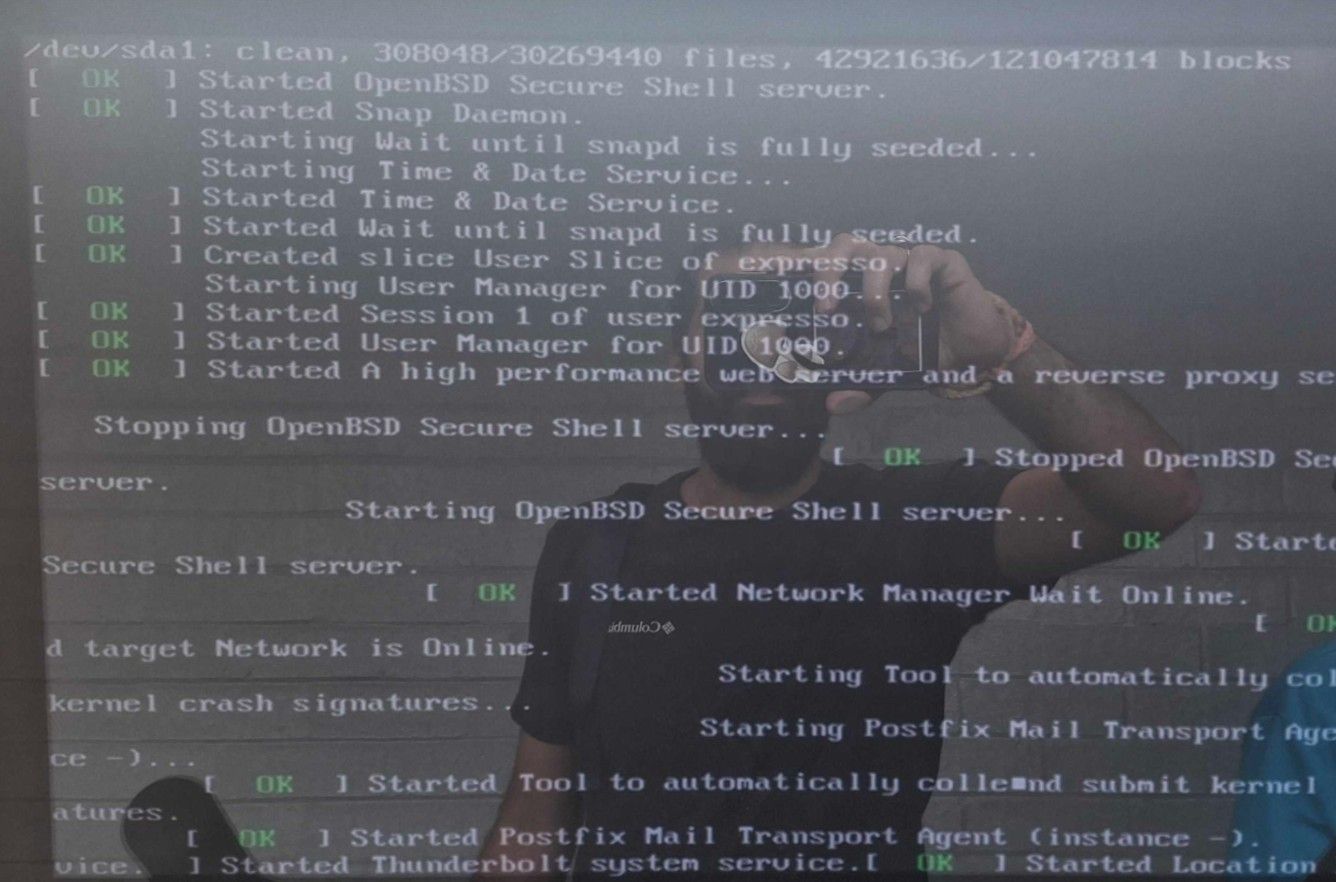
    I recently visited a local YMCA branch and spotted a treadmill booting up... powered by OpenBSD.

    A crazy discovery xD If I can power a treadmill with OpenBSD then I'll attempt any embedded project with it.

    abe42f93-9f03-41c8-8ccd-e0bfc017b6de-image.jpeg
    0e924423-d9b1-450c-9cba-9b6e157c6fac-image.jpeg


    read more →
    Thanks to everyone who pointed out Linux. Now that I'm paying attention this is clearly the systemd startup logging.
  • naltunN

    tl;dr I used wg(4), pf(4), and relayd(8), all OpenBSD native tools, to encrypt all inbound connections from a gateway VPS to my local home server. This also hides my local IP information and I managed it all without much hassle and pain.

    I recently stood up a VPS running OpenBSD 7.9 on Vultr. The VPS is hosted in Chicago, Illinois, USA. I then took OpenBSD's native WireGuard driver, wg(4), to establish an encrypted tunnel to my local home lab server. Using relayd(8), OpenBSD's native reverse proxy, I can now forward virtual host connections to my home lab server, which has httpd(8) as a web server frontend. I used pf.conf(5) to configure OpenBSD's native fireweall, pf(4), which was incredibly easy.

    The result is a secure gateway that routes all traffic via WireGuard to my local server, obfuscating its location and other IP information. This was done by simply configuring handful of system daemons. I've done some OpenBSD network configuration before, but this was the most work I've done. The best part, it wasn't that difficult, and all manual pages provided sufficient details to work with them.

    Once I get my site set up I'll write up the experience and step-by-step instructions and share the page here.

    New OpenBSD milestone unlocked; no intent to stop anytime soon

    Happy hacking, hackers!


  • CiotBSDC

    26/07/12

    ⇒ Leanpub Book LAUNCH 🚀 Three Essays on NetBSD by Chris Pinnock

    This book collects three essays I wrote in 2022 about the NetBSD operating system.


  • CiotBSDC

    06/28

    ⇒ Linux 7.3 To Introduce DRM "Color Format" Property With AMD GPU Driver Support

    While the Linux 7.2 kernel merge window is only ending later today to cap off the feature work on this next version of the Linux kernel, already for the Linux 7.3 kernel cycle later in the year there is one notable feature on the way: the DRM color format property is being introduced and being first supported by the AMDGPU kernel graphics driver.


    26/07/10 ⇒ Linux 7.3 Enabling Second Graphics Pipe For Modern AMD APUs AMD on Thursday sent out another round of AMDGPU kernel graphics driver and AMDKFD kernel compute driver updates to DRM-Next of new feature material ahead of the Linux 7.3 merge window. https://www.phoronix.com/news/Linux-7.3-Second-Pipe-GFX11-APU 26/07/12 ⇒ Reworked System Call Entry Handling Slated For Linux 7.3 Stemming from looking at a proposed Linux kernel patch to alter the Linux kernel's system call number handling, veteran Linux kernel developer Thomas Gleixner went down a rabbit hole of the kernel's system call entry handling to make a number of clean-ups and improvements to the code. That rework to the system call entry handling is now expected to land for the Linux 7.3 kernel cycle. https://www.phoronix.com/news/Rework-Sysclal-Entry-Linux-7.3
  • CiotBSDC

    26/07/04

    ⇒ How to fix Homebox 0.26.2 not starting on FreeBSD

    After upgrading my Homebox jail yesterday from 0.25.2 to 0.26.2, the homebox service would not start anymore. Taking a look into /var/log/homebox.log, I got presented with the following error message: